Pilates at KNÓSIS for Back Pain
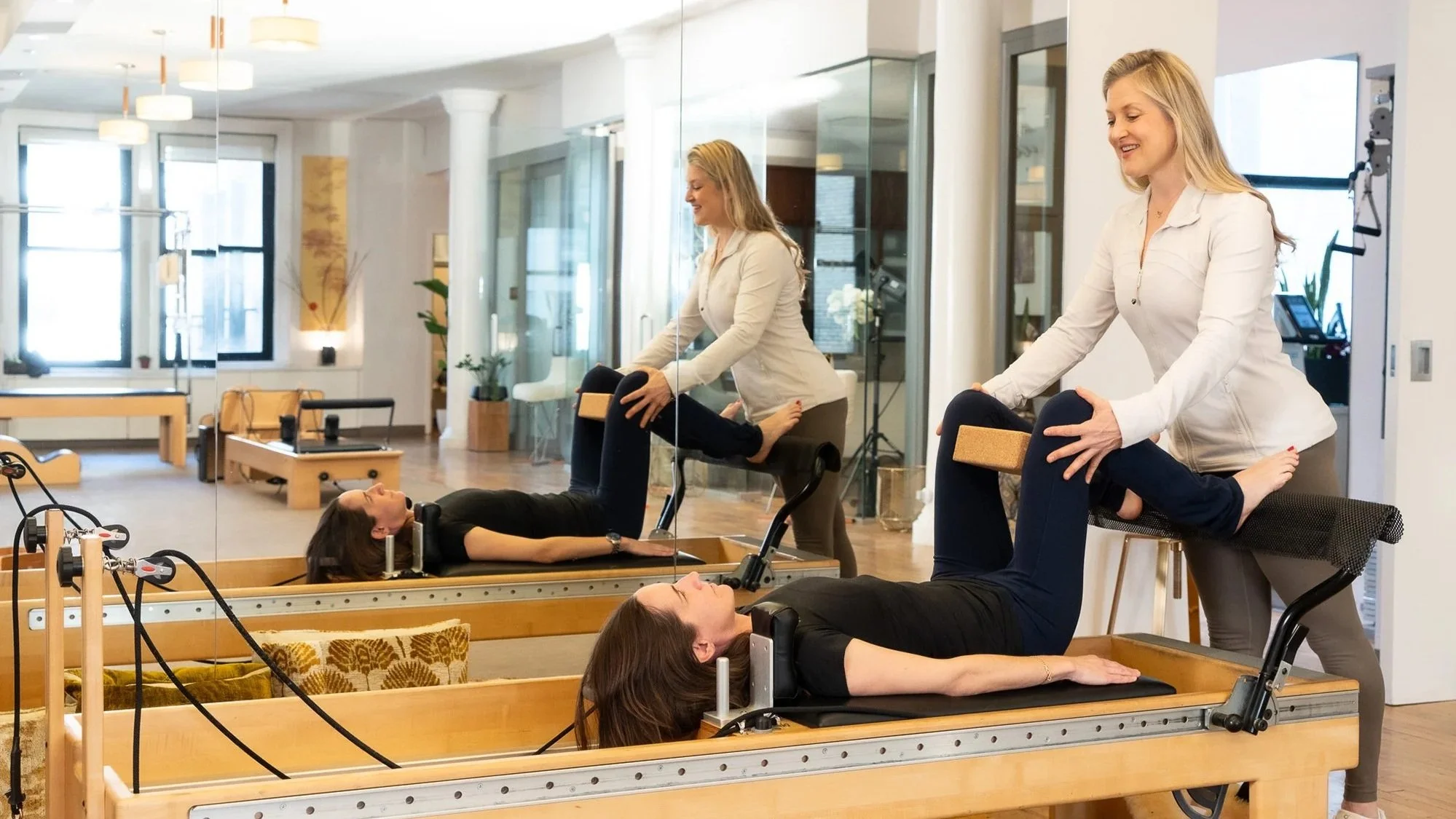
Not all Pilates is the same—particularly when working with pain.
For individuals with back pain, the quality of instruction and the clinical understanding behind it make a significant difference.
At KNÓSIS, Pilates is not approached as a standalone fitness modality. It is integrated within a clinical framework, working closely alongside physical therapy.
The Pilates practitioners and physical therapists collaborate, ensuring that movement strategies align with each patient’s diagnosis, presentation, and stage of recovery. This continuity of care allows for a more precise and individualized approach.
The team’s training reflects this depth. The Pilates Instructors are National Pilates Certified, Polestar Pilates, Balanced Body and Physical Mind Certified. These practitioners have studied with Mark Comerford, whose work in movement dysfunction and motor control is widely respected in rehabilitation. They have also trained under Pablo Marinho, developing a strong foundation as Movement Science Practitioners.
Ongoing education remains a core part of the approach. The team continues to train under Tracey Vincel, whose work integrates advanced clinical reasoning with a nuanced understanding of spinal health and movement.
This level of training allows for a more refined application of Pilates—one that is responsive to the complexities of back pain rather than generic in its delivery.
Why Pilates Helps Back Pain
Back pain reflects a system that has lost its balance—its rhythm, its support, its ability to move with ease and coordination.
Pilates, when practiced with awareness and intention, becomes something much more than exercise. It becomes a way of restoring connection within the body.
Back Pain Is a Whole-System Experience
When someone has with back pain, it’s rarely just about the spine.
What matters just as much is:
How they breathe
How they shift weight
How they organize themselves against gravity
Where they hold tension—and where they’ve lost connection
The body functions in layers—joint structures, soft tissues, muscles, and the nervous system—all influencing one another.
When these layers stop communicating effectively, the spine often compensates by doing more than it was designed to handle.
Pilates Reintroduces Safe, Thoughtful Movement
One of the quieter challenges in back pain is fear.
It may not always be obvious, but it shows up in guarded movement, avoidance, or unnecessary bracing.
Pilates offers a different experience:
Slower, more intentional movement
Lower load, with higher awareness
A focus on how you move, not just what you do
This distinction is important.
Healing isn’t only about building strength—it’s about restoring trust in movement.
The Deep Core
There is a layer of support in the body that isn’t visible, but is essential for spinal health.
The deep core system—your diaphragm, pelvic floor, transversus abdominis, and multifidus—functions as an internal stabilizing network.
Ideally, these muscles activate in anticipation of movement.
In many individuals with back pain, that timing is disrupted.
The body adapts:
Larger muscles begin to overwork
Movement becomes more rigid
Load shifts into joints and passive structures
Pilates helps retrain this inner system—not through force, but through precision, timing, and awareness.
Breath
Breathing plays a central role in recovery, though it is often overlooked.
It influences:
Core stability
Nervous system regulation
Internal pressure that supports the spine
Breathing habits can significantly affect physiology, including the regulation of carbon dioxide and acid-base balance—factors that influence how the body feels and performs.
When breathing becomes shallow or disconnected from movement, efficiency is lost.
In Pilates, breath is integrated into every movement.
Over time, this supports not only better movement patterns, but a more balanced internal state.
Restoring Balance, Not Forcing Strength
Back pain often develops when certain areas of the body begin to compensate for others.
For example:
Limited hip mobility and thorax mobility can shift strain into the lower back
Poor pelvic control can alter spinal mechanics
Weak or delayed stabilizers can create subtle instability
Research shows that deficits in strength and control around the hips and trunk can directly contribute to pain and dysfunction.
Pilates addresses these imbalances by reconnecting the system, allowing load to be shared more efficiently.
Movement becomes more coordinated, less effortful.
The Nervous System
Pain is not solely a reflection of tissue damage.
It is also shaped by how the nervous system interprets movement.
With persistent pain, the system often becomes more protective:
Muscles tighten unnecessarily
Movement becomes guarded
Sensitivity increases
Pilates works with the nervous system through:
Slow, controlled repetition
Attention to sensation
Gradual progression
This creates new movement options and helps reduce protective responses over time.
Restoring Balance
The goal is not simply to eliminate pain.
It is to restore ease, adaptability, and resilience within the body.
This often requires a shift:
From pushing through → to listening
From isolating muscles → to integrating movement
From short-term relief → to sustainable change
Pilates supports this process by guiding the body back toward balance, rather than forcing it into position.